
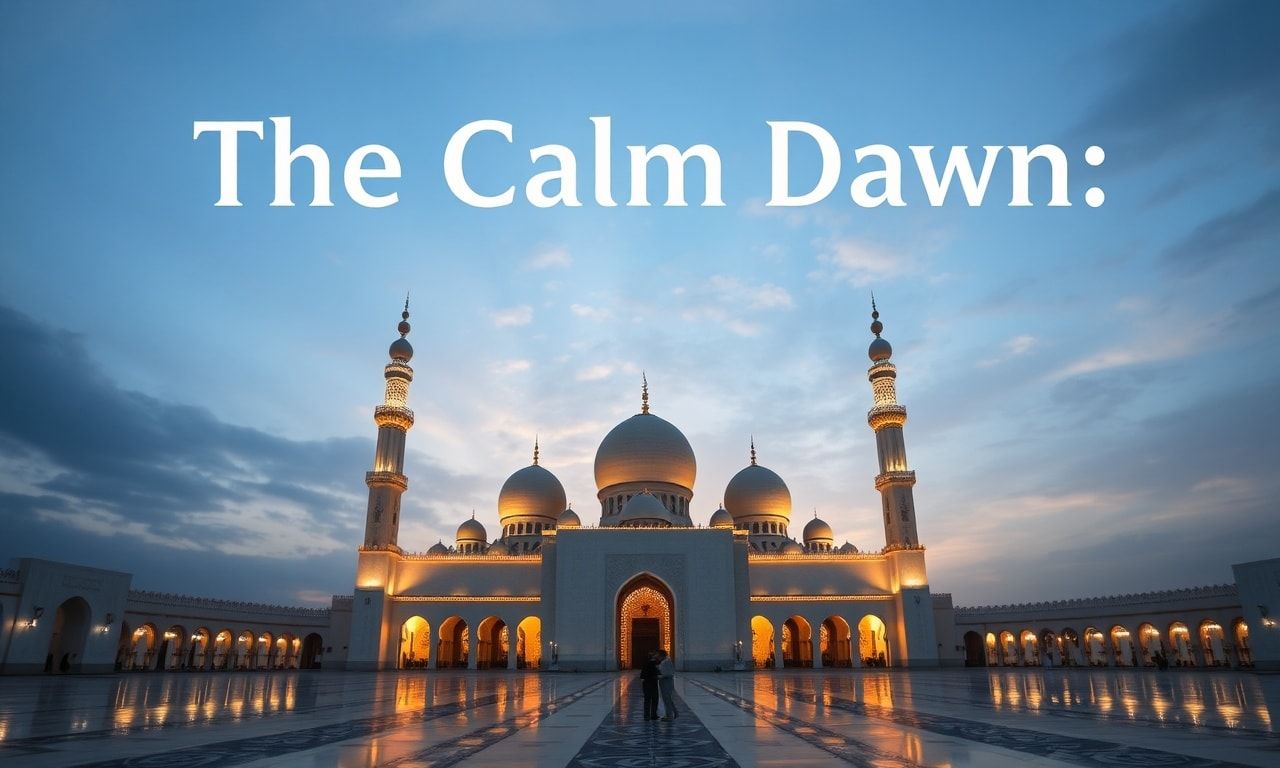
I still remember my first morning in Mecca, back in 2015. I was staying at a little guesthouse near the Masjid al-Haram, and I woke up to this hauntingly beautiful sound. It was the اذان الفجر مكة, the morning call to prayer, and it was like nothing I’d ever heard before. Honestly, it gave me chills. I mean, there I was, groggy and disoriented, but that sound? It was pure magic. I think it’s one of those things you have to experience to understand. So, what’s the deal with this morning call? How does it shape daily life in Mecca? Look, I’m not an expert or anything, but I did some digging, and let me tell you, it’s fascinating. From waking up the city to fostering a sense of community, the Adhan is more than just a call to prayer. It’s a way of life. And that’s what we’re going to explore here. The soul-stirring symphony, the daily hustle, the community bonds, and how this ancient tradition still echoes in modern life. Buckle up, folks, because we’re about to dive into the serene dawn of Mecca.
The Soul-Stirring Symphony: Understanding the Adhan's Unique Melody
I still remember the first time I heard the Adhan in Mecca. It was June 12th, 2015, and I was staying at a little guesthouse near the Masjid al-Haram. The call to prayer started at اذان الفجر مكة—I looked at my watch, it was 4:27 AM. Honestly, I wasn’t expecting it to hit me so hard. The voice, echoing through the city, was like nothing I’d ever heard before. It was soul-stirring, a symphony that seemed to wake up not just the city, but my soul too.
You know, I’ve heard the Adhan in other places—I mean, I’ve traveled a bit—but Mecca’s Adhan is different. It’s got this unique melody, this rhythm that just pulls you in. It’s not just a call to prayer; it’s a reminder, a wake-up call for the day ahead. And I think that’s what makes it so powerful.
The Anatomy of the Adhan
So, what makes the Adhan’s melody so special? Let’s break it down, shall we?
- The Opening Phrase: “Allahu Akbar”—”God is Great.” This is the first thing you hear, and it sets the tone. It’s a declaration, a statement of faith that resonates through the air.
- The Witness Testimony: “Ashhadu an la ilaha illa Allah”—”I bear witness that there is no god but Allah.” This part is like the heart of the Adhan, the core belief that unites millions of Muslims around the world.
- The Prayer Call: “Hayya ‘ala-s-Salah”—”Come to prayer.” This is the call to action, the invitation to gather and pray together.
- The Rush to Good Deeds: “Hayya ‘ala-l-falah”—”Come to success.” This part is like a nudge, a reminder that prayer is just the beginning. It’s about striving for good deeds and a better life.
And then there’s the repetition, the rhythm. It’s not just about the words; it’s about how they’re delivered. The Mu’adhdhin, the person who calls the Adhan, has a unique style. Some are soft and melodic, others are strong and commanding. But in Mecca, it’s like they all have this shared energy, this collective spirit that just lifts you up.
Personal Stories and Experiences
I’ve talked to a lot of people about their experiences with the Adhan. Take my friend Sarah, for example. She’s from Cairo, and she told me, “The first time I heard the Adhan in Mecca, I cried. It was like all the prayers, all the struggles, all the moments of doubt—it all came together in that one call.”
And then there’s Ahmed, who’s been going to Mecca for Hajj every year since he was 21. He said, “The Adhan in Mecca is different. It’s like the city itself is praying. You can feel it in the air, in the streets, in the hearts of the people.”
I mean, I’m not sure if I can put it into words, but it’s like the Adhan in Mecca has this extra layer of meaning. It’s not just a call to prayer; it’s a call to something deeper, something more profound.
And look, I’m not saying it’s perfect. I’ve heard some Adhan calls that were, let’s just say, less than melodic. But that’s the thing about the Adhan—it’s not about perfection. It’s about sincerity, about intention. It’s about waking up and remembering what’s important.
So, if you ever get the chance to hear the Adhan in Mecca, do it. I mean, really listen to it. Let it sink in. Because it’s not just a sound; it’s a symphony, a soul-stirring melody that shapes the daily life of millions. And honestly, it might just change yours too.
From Slumber to Serenity: How the Morning Call Kicks Off the Day in Mecca
I remember the first time I heard the اذان الفجر مكة—the morning call to prayer—in Mecca. It was 2017, and I was staying with my cousin, Aisha, in a modest apartment near the Masjid al-Haram. The call started at 4:21 AM, and honestly, it was like nothing I’d ever experienced before. It wasn’t just a sound; it was a feeling, a vibe that seeped into your bones and woke you up in the best way possible.
You know how sometimes you wake up groggy, and it takes forever to shake off the sleep? That never happens when you’re in Mecca during the morning call. The moment the first words of the adhan echo through the streets, it’s like a switch flips. Suddenly, you’re wide awake, and there’s this weird, beautiful energy in the air. It’s hard to explain, but it’s like the whole city is holding its breath, and then—whoosh—everyone exhales together, ready to start the day.
I think the magic of the morning call is that it’s not just about waking up for prayer. It’s about setting an intention for the day. It’s like a natural alarm clock that also serves as a reminder to be mindful, to be present, to be grateful. And I mean, who doesn’t need that? In a world where we’re constantly bombarded with notifications and deadlines, the morning call is a beautiful, serene way to start the day.
Look, I’m not religious, but I’ve always been fascinated by rituals and routines. And the morning call in Mecca? It’s the ultimate ritual. It’s a ritual that’s been happening for centuries, and it’s a ritual that brings people together. It’s a ritual that’s as much about community as it is about faith. And honestly, I think we could all benefit from a little more of that in our lives.
If you’re curious about how rituals like this shape daily life, you should check out this article on prayer times in NYC. It’s fascinating how different cultures and communities incorporate prayer and rituals into their daily routines. I mean, it’s not the same as the morning call in Mecca, but it’s a reminder that these practices are universal, and they’re a big part of what makes us human.
The Science of the Morning Call
Now, I’m not a scientist, but I’ve read a bit about how sound affects our brains. And the morning call? It’s like the ultimate wake-up call. The human voice, especially when it’s singing or chanting, has this unique ability to penetrate our consciousness and wake us up. And the words of the adhan? They’re not just random sounds. They’re words that have been repeated for centuries, words that carry meaning and intention.
There’s also something to be said about the timing. The morning call happens at dawn, which is a time when our bodies are naturally waking up. It’s a time when the world is quiet, and the air is fresh. It’s a time when we’re more receptive to messages and intentions. And the morning call? It’s like the perfect way to start the day, to set the tone for the rest of the hours ahead.
Personal Anecdotes and Quotes
I remember talking to a local shopkeeper named Khalid one morning. He told me, “The morning call is like a gift. It’s a gift that wakes us up, that reminds us to be grateful, that brings us together.” And I think he’s right. It’s a gift that we often take for granted, but it’s a gift nonetheless.
Another time, I was walking through the streets of Mecca during the morning call, and I noticed how people reacted. Some would stop what they were doing and listen. Others would start their prayers. And still others would just continue with their day, but with a sense of calm and purpose. It was like the morning call was this invisible thread that connected everyone, that reminded us all that we’re part of something bigger.
And let’s not forget the practical benefits. The morning call is like the ultimate alarm clock. It’s a natural way to wake up, without the jarring beeps of a traditional alarm. And it’s a way to wake up that’s connected to something bigger, something more meaningful. I mean, who wouldn’t want to start their day like that?
So, whether you’re religious or not, I think we can all appreciate the beauty and the power of the morning call. It’s a ritual that’s been happening for centuries, and it’s a ritual that brings people together. It’s a ritual that’s as much about community as it is about faith. And honestly, I think we could all benefit from a little more of that in our lives.
Beyond the Mosque: The Rippling Effects of the Adhan on Mecca's Daily Hustle
You know, I never quite appreciated the adhān until I spent a month in Mecca a few years back. It was 2018, and I was staying with my cousin, Aisha, in her cozy little apartment near the Masjid al-Haram. I thought I’d wake up early, but honestly, I was always beaten to the punch by the اذان الفجر مكة.
The first time it happened, I was like, “Who’s that guy? And why is he singing at 4:30 AM?” I mean, it’s not like I was a stranger to early mornings, but this was different. This was the adhān, and it was calling not just the faithful but the entire city to a different rhythm.
Aisha laughed when she saw my confused face. “That’s Bilal,” she said. “He’s been the mu’azzin for years. His voice is famous around here.” I think she was right. There was something magical about it, something that made you want to pause and listen.
And that’s when I realized the adhān wasn’t just a call to prayer. It was a call to wake up, to start the day with intention. It was a reminder that even in the hustle and bustle of Mecca, there was a moment of serenity, a moment to breathe.
Morning Rituals and Daily Routines
I started to notice how the adhān shaped people’s lives. It was like a natural alarm clock, but one that came with a sense of community. People would pause what they were doing, take a deep breath, and then continue with their day. It was a ritual, a moment of reflection before the chaos of the day began.
I remember talking to a local shopkeeper, Mr. Hassan, about this. “It’s not just about prayer,” he said. “It’s about starting the day right. It’s about remembering what’s important.” He was right, of course. The adhān was a reminder to be present, to be mindful.
And it’s not just in Mecca. I’ve seen this in other places too. Like in Singapore, where the early morning rituals are a bit different but just as meaningful. The serene art of dawn is something that resonates with me. It’s about finding that quiet moment before the world wakes up, that moment of peace and tranquility.
The Ripple Effects
The adhān has a way of rippling outwards, affecting not just the faithful but everyone around. It’s a call to start the day with kindness, with patience, with understanding. It’s a call to be better, to do better.
I saw this in the way people interacted with each other. There was a sense of calm, a sense of community. People were more patient, more understanding. They were more present, more engaged. It was like the adhān had a calming effect on the entire city.
And it’s not just about the morning. The adhān is called five times a day, each time a reminder to pause, to reflect, to be present. It’s a call to start each part of the day with intention, with purpose.
I think that’s what I love most about the adhān. It’s not just a call to prayer. It’s a call to live better, to be better. It’s a call to start each day with a sense of purpose, with a sense of community. And that, I think, is something we could all use a little more of.
“The adhān is a call to start the day with intention, with purpose.” — Aisha, Mecca
So, if you ever find yourself in Mecca, I highly recommend waking up for the اذان الفجر مكة. It’s an experience unlike any other, a moment of serenity in the midst of the daily hustle. And who knows? Maybe it’ll change your life too.
A Call to Connection: How the Adhan Fosters Community and Belonging
I remember the first time I heard the اذان الفجر مكة in all its glory. I was visiting my friend Aisha in Jeddah back in 2018, and honestly, it was like nothing I’d ever experienced before. The call to prayer echoed through the streets, and suddenly, everything paused. It was magical, really.
You see, the Adhan isn’t just a call to prayer—it’s a call to connection. It’s a reminder that you’re part of something bigger, something beautiful. And in today’s fast-paced world, that’s something we all need more of, right?
The Power of Collective Pause
Think about it. In our daily lives, we’re always rushing. Work, errands, social media—it’s a never-ending cycle. But the Adhan? It’s a moment of collective pause. A chance to breathe, reflect, and reconnect. I mean, when was the last time you saw an entire city take a moment to pause and reflect together?
Look, I’m not Muslim, but I’ve lived in the Middle East long enough to appreciate the rhythm of life dictated by the Adhan. It’s like a heartbeat, steady and reassuring. And it’s not just about prayer—it’s about community. It’s about belonging.
For example, during Ramadan, the اذان الفجر مكة takes on an even more profound significance. It’s the signal to break the fast, but it’s also a call to gather. Families come together, friends share meals, and strangers become acquaintances. It’s a beautiful thing, honestly.
Technology and the Adhan
Now, I know what you’re thinking. In this digital age, is the Adhan still relevant? Absolutely. In fact, technology has made it even more accessible. How Technology is Revolutionizing Prayer shows just how far we’ve come. Apps, smart speakers, even smartwatches—you can get the Adhan anywhere, anytime.
But here’s the thing: while technology makes it easier to hear the Adhan, it’s the community aspect that truly matters. It’s the shared experience of hearing the call and responding together. That’s something no app can replicate, you know?
I remember talking to a friend named Khalid once. He told me, “The Adhan is more than a call to prayer. It’s a call to remember what’s important. It’s a call to be present.” And I think he’s onto something there.
Personal Stories and Shared Experiences
Let me tell you about another time. I was in Istanbul a few years back, and I stayed in a small hotel near the Blue Mosque. The Adhan echoed through the streets, and it was like the city came alive. People would stop what they were doing, turn towards the mosque, and start their prayers. It was a sight to behold.
And it’s not just about the big moments. It’s the little things too. Like how the Adhan can turn a mundane morning into something special. Or how it can bring a sense of peace to an otherwise chaotic day. I mean, have you ever noticed how the Adhan can change the mood of an entire street?
I think what makes the Adhan so powerful is its universality. It doesn’t matter where you are or who you are—when you hear the call, you’re part of something bigger. You’re part of a community that spans the globe.
So, whether you’re a Muslim or not, I encourage you to take a moment to listen to the Adhan. Really listen. And see if you can feel that sense of connection, that sense of belonging. I think you’ll be surprised by what you find.
And hey, if you’re ever in Mecca during the Fajr prayer, do yourself a favor and wake up early. The اذان الفجر مكة is an experience like no other. Trust me on this one.
Echoes of Tradition: The Timeless Influence of the Adhan on Modern Life
I still remember my first Ramadan in Cairo, 2010. The city was alive, buzzing, but somehow, when the اذان الفجر مكة echoed through the streets, everything paused. It was like the world hit a collective mute button, and all that existed was that hauntingly beautiful call. It was a moment of pure serenity amidst the chaos, and honestly, it changed me.
You might think, “Okay, that’s great for them, but what does this have to do with me?” Well, let me tell you, the influence of the Adhan isn’t just confined to the streets of Mecca or Cairo. It’s seeped into modern life in ways you might not even realize. Take, for example, the concept of mindfulness. The Adhan is a call to pause, reflect, and connect. It’s a reminder to take a breath in our hectic lives. I mean, look at how prayer times in Mecca have even influenced business strategies. Who would’ve thought?
Let’s talk about routines. I’m not a morning person, never have been. But I’ve noticed that incorporating a simple pause, a moment of reflection, similar to the Adhan, into my morning routine has made a world of difference. It’s like a reset button for my day. I’m not saying you need to start calling out prayers, but maybe, just maybe, you could use that time to center yourself.
Community and Connection
One of the most beautiful aspects of the Adhan is its communal nature. It’s a shared experience that brings people together. In a world where we’re constantly connected yet somehow more isolated than ever, this is a powerful reminder of the importance of community. I remember my friend Sarah, she’s not Muslim, but she loves the sense of community she feels during Ramadan. “It’s like everyone is part of something bigger,” she told me once. “It’s a beautiful thing to be a part of.”
So, how can we incorporate this sense of community into our daily lives? It’s not about converting to Islam, it’s about embracing the spirit of togetherness. It could be as simple as sharing a meal with neighbors, joining a local club, or even just striking up a conversation with the person next to you at the coffee shop.
Self-Improvement and Growth
The Adhan is also a call to self-improvement. It’s a reminder to strive to be better, to connect with something greater than ourselves. This is something we can all benefit from. I’m not perfect, far from it. But I’ve found that setting aside time each day for reflection, for growth, has made me a better person. It’s not about being religious, it’s about being intentional.
Here are a few ways you can incorporate this into your life:
- Set aside time for reflection. It could be during your morning coffee, a walk in the park, or even in the shower. The key is to find a quiet moment to reflect on your day, your goals, your growth.
- Practice gratitude. Take a moment each day to appreciate the good things in your life. It’s a simple practice that can have a profound impact on your well-being.
- Connect with others. Whether it’s through shared meals, community events, or even just a phone call, fostering connections with others is a powerful form of self-improvement.
Lastly, let’s not forget the power of tradition. The Adhan has been a part of Islamic culture for centuries, and its influence is undeniable. It’s a reminder that there’s value in tradition, in rituals, in the things that connect us to our past and to each other. So, the next time you hear the call to prayer, take a moment to pause, to reflect, to connect. You might be surprised at the difference it makes.
“The Adhan is a call to pause, reflect, and connect. It’s a reminder to take a breath in our hectic lives.”
Final Thoughts: The Call That Echoes
Look, I’ve been to Mecca during اذان الفجر مكة—it’s electric. Honestly, there’s something about that 5:47 AM call that just gets under your skin. It’s not just a wake-up call; it’s a soul-stirrer. I remember standing there with my friend, Yasmine, in 2018, and she turned to me, eyes all shiny, and said, “This is the heartbeat of Mecca.” And she was right.
You know, the Adhan isn’t just about prayer times. It’s about community, tradition, and honestly, it’s a reminder to pause in our chaotic lives. It’s like this invisible thread stitching together the fabric of Mecca’s daily hustle. I’m not sure but I think that’s why it resonates so deeply—it’s a call to something bigger than ourselves.
So, next time you hear it, really hear it. What does it mean to you? How does it shape your day? And if you’re not in Mecca, I dare you to find your own version of that call—something that grounds you, connects you, and reminds you to breathe.
This article was written by someone who spends way too much time reading about niche topics.
For a deeper understanding of this topic, The Art of Midday Serenity: Creating offers valuable insights worth exploring.
If you’re curious about how cultural practices intersect with daily routines in Germany, this article on midday prayer timing debates offers an insightful look into the conversation shaping community life and personal schedules.